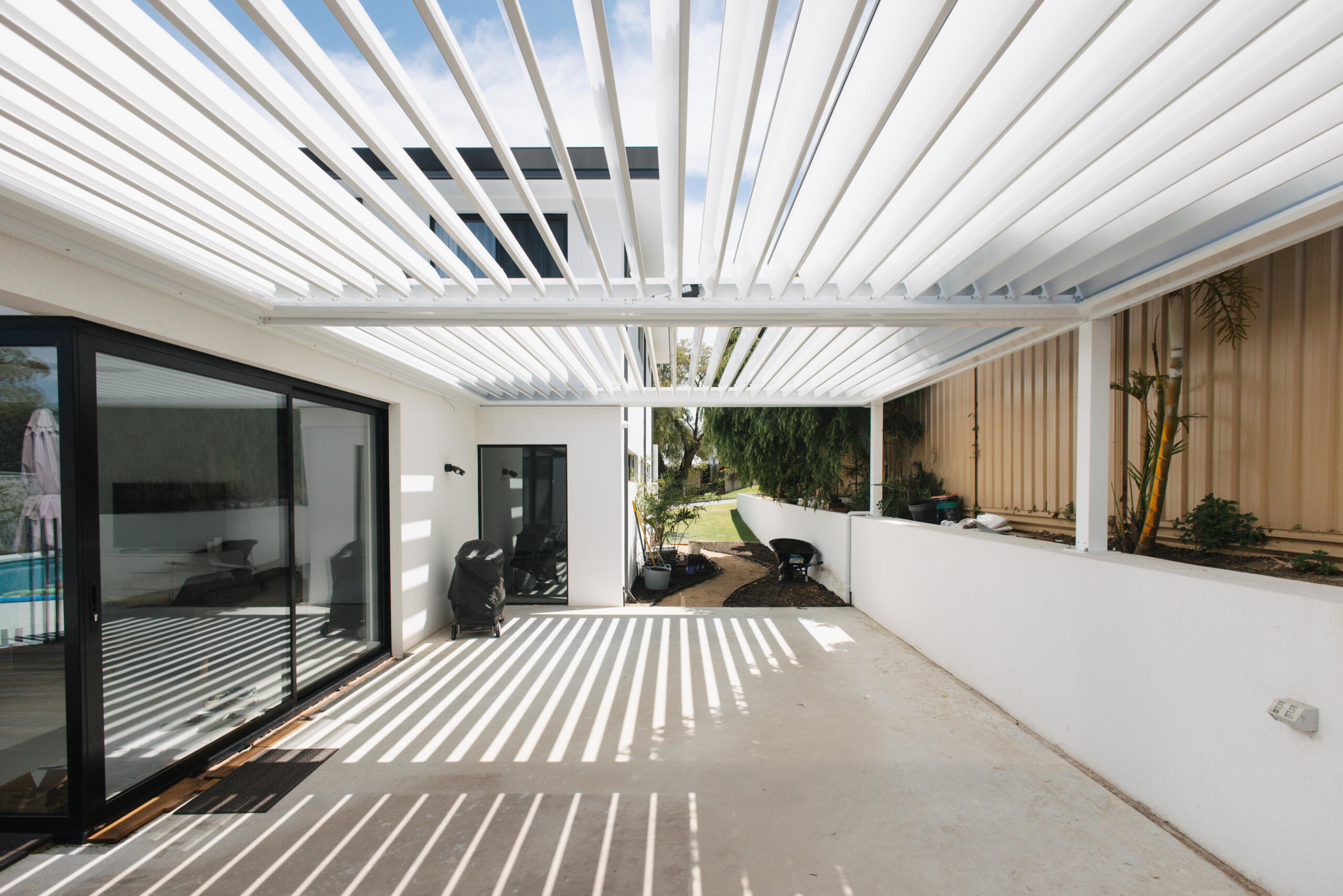
A small paved courtyard can easily take a louvred pergola. It does not need four posts, it does not need a large span, and it does not need power run to it. The job most people picture when they imagine a louvre roof is a big alfresco, which is why the smaller version stays invisible.
The courtyard is a real Perth housing type
If you are looking at a louvre pergola Perth homeowners with compact blocks often assume their space is too small. Small paved courtyards are standard across the established suburbs, particularly on narrow blocks and in the older western suburbs stock. They tend to be the space between the house and the boundary, often hard against a wall, often too hot in the afternoon and useless once it rains.
Across the enquiries Cover Co receives, most people who quote a size describe something between three and six metres. Courtyards sit at the smaller end of that, and a job at the smaller end is not an edge case. It is a normal job.
What changes when the space is small
Three things change, and all of them work in your favour.
Mounting: A courtyard against a house wall often does not need a freestanding four-post frame. A two-post, wall-mounted configuration uses the existing wall for support, which keeps posts out of a space that has none to spare. Where there is already a frame or structure standing, the roof can sometimes be retrofitted to it rather than replacing it.
Operation: Small courtyards frequently have no power. A hand-operated louvre system runs off a gearbox with no wiring and no automation, so the roof works in a space where running power would otherwise be the first and largest job. The blades rotate through 90 degrees, so you still get the full range from open to closed.
Structure: Shorter spans mean fewer posts and lighter framing. The engineering still has to account for the wind exposure of the specific site, but a small courtyard tends to be a more sheltered site to begin with.
What it does day to day
Closed, the blades sit flat and the integrated gutter takes water out through the downpipes. Open, the courtyard gets light and airflow rather than the closed-in feeling that a solid roof gives a small space.
That last point matters more in a courtyard than anywhere else. A solid roof over a three-metre courtyard makes it dark, and a dark courtyard beside a living area makes the living area darker too. Blades that open keep the light and still give you somewhere to sit when it rains.
Why a manual system makes sense for small spaces
Motorised operation earns its place on a large alfresco used constantly, where getting up to crank a roof is the difference between using the space and not.
On a small courtyard, the calculation is different. The span is short, the operation is quick, and there are no motors, wiring or sensors to specify, install or maintain. Choosing manual here is not a compromise, it is the appropriate system for the job. The blades do exactly the same thing.
What the system is made of
The same materials go into a small system as a large one. Marine grade aluminium and stainless steel fixings, which matter on coastal and near-coastal blocks where salt gets into everything. A minimum structural thickness of 2mm across the profiles. Powder-coated finishes that resist chipping, peeling and UV. Concealed fixings and ground anchors, so the finished roof reads as part of the house rather than something bolted onto it.
If your courtyard is the space you never use
Small outdoor areas get written off early. Blasted by heat at midday, unusable when it rains, so the furniture ends up in the shed and the space becomes a walkway.
A roof that opens and closes is what changes that, and the size of the courtyard is not the obstacle people assume it is.
See the manual louvre roof range, or tell us the dimensions of your courtyard and what it backs onto, and we will tell you what fits.
Questions people actually ask about courtyard louvre roofs
Is a courtyard too small for a louvre roof?
No. Most people who quote a size describe a space between three and six metres, and courtyards sit within that range. Smaller spans generally need fewer posts, not more.
Can a louvre roof be fixed to a wall instead of standing on four posts?
Yes. A two-post, wall-mounted configuration uses the existing wall for support, which suits a courtyard where floor space is tight.
Do I need electricity for a louvre roof?
Not for a hand-operated system. It uses a gearbox with no wiring or automation, so it works in a courtyard with no power available.
How far do the blades rotate on a manual system?
Through 90 degrees, from fully open to closed flat.