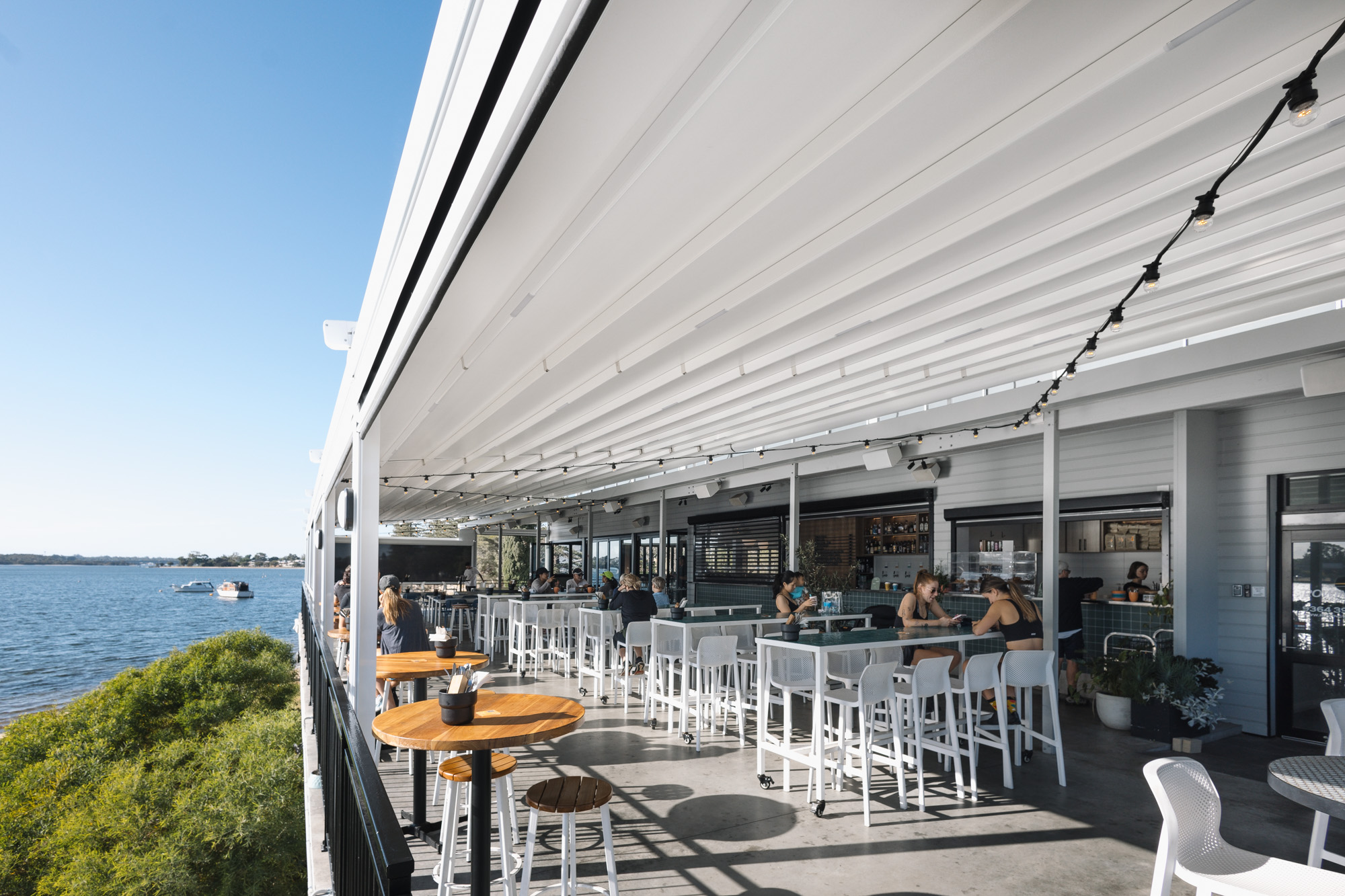
In Perth, outdoor living spaces are a primary design focus, but the word buyers actually search for isn’t “louvre roof” – it’s “patio roof.” Across hundreds of Cover Co enquiries, “patio” comes up far more often than any specific product name. Before talking systems and brands, it’s worth answering the question the way people are asking it: what are the options for a patio roof?
There are really four, and each one does a different job.
A roof that opens and closes
This is a louvre-style roof: aluminium blades that rotate to let light and airflow through on a good day, then close flat to shed rain when the weather turns. The appeal is flexibility – the same structure handles a still, sunny afternoon and a sudden downpour without anyone needing to move a cover or bring in the furniture. The trade-off is that it’s a mechanical system, which means there’s more to it than a fixed sheet of roofing.
A roof that disappears completely
A retractable roof – fabric or panelled – slides back to open the space to full sky, then closes over when needed. If having open sky matters more than shelter on demand, this option is built around that. It suits entertaining areas where the priority is feeling outdoors, with weather protection as the secondary job rather than the main one.
A roof that blocks everything, permanently
A solid or insulated patio roof is fixed in place. No moving parts, no operation to think about, just permanent shade and weather protection. It’s the simplest option mechanically, and for a space that’s always going to be a patio rather than sometimes a patio and sometimes an open deck, that simplicity is the whole point.
A roof that sheds water on a pitch
A gable or pitched patio roof uses roof angle rather than mechanics to move water away. It’s a familiar shape for a reason – it works well on larger spans and pairs naturally with the existing roofline of a house, which matters for anyone wanting the patio to look like part of the home rather than an add-on.
Comparing the four side by side
| Option | Weather flexibility | Open sky | Moving parts | Best suited to |
| Louvre (operable) | High – opens and closes as needed | Partial, when open | Yes | Spaces used year-round in changeable weather |
| Retractable | Moderate – retracts fully, closes fully | Full, when open | Yes | Entertaining areas prioritising open sky |
| Fixed/insulated | None – always closed | None | No | Permanent shade, low-maintenance preference |
| Pitched/gable | None – always closed | None | No | Larger spans, matching an existing roofline |
None of these is the universally “right” answer – it depends on whether the priority is flexibility, simplicity, open sky, or matching the house. Perth brings hard sun and sudden, heavy rain. A roof that responds to both in the same afternoon is why the louvre option usually comes out ahead once people compare rather than just pick the first thing they see.
Perth’s wind is part of this decision too
Any patio roof in Perth has to handle wind, not just rain. Exposure varies across the metro. River corridor suburbs like Attadale, Applecross, Como, and East Fremantle face different wind profiles than western suburbs like Nedlands, Floreat, and Booragoon depending on how sheltered or exposed the block is. It’s a genuine engineering factor in choosing and installing any of the four options above, not just a footnote.
Which one fits your space?
The right patio roof depends on your block, your budget, and how you plan to use the space. Explore Cover Co’s patio roof options to see how each type performs in a Perth backyard.