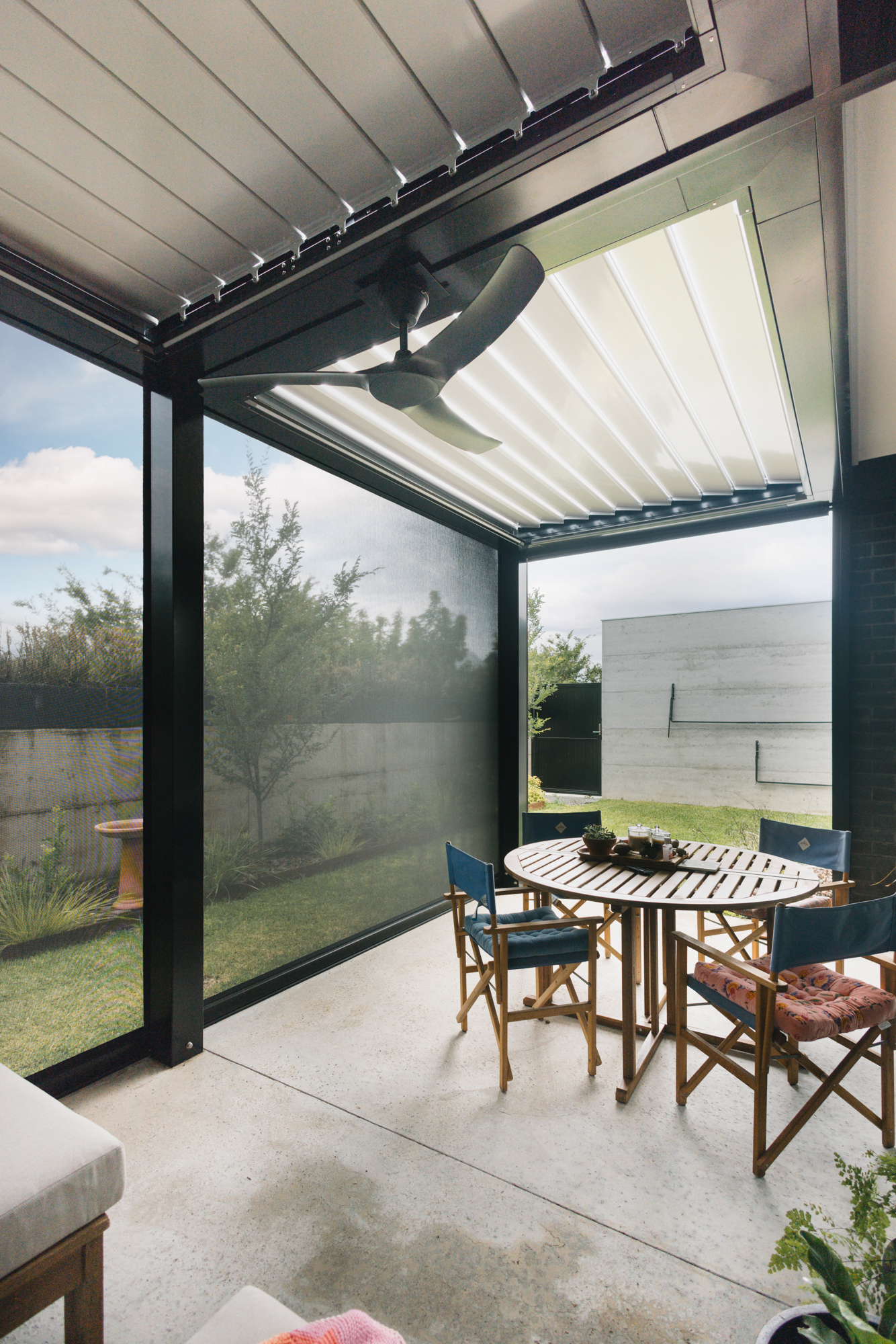
Yes, you can put a roof on a pergola you already own. If the frame is structurally sound, the roof is a separate decision from the structure holding it up. That single point is where most pergola projects in Perth start, and where most of them stall.
Plenty of people assume that wanting shade and rain cover means pulling the whole thing down and starting again. Often it does not. What follows is the four ways a pergola gets roofed, what each one actually does, and how to work out which suits the frame in your backyard.
The frame and the roof are two different decisions
A pergola is the structure: posts, beams and rafters. The roof is what sits on top of it, and on a lot of older Perth pergolas there is nothing on top at all, or there are open slats that break up the sun without stopping it.
So there are two questions, not one. Is your existing structure sound enough to become a pergola with roof protection, and which roof type fits? An assessment answers the first. This article deals with the second.
If the frame is not sound, or if there is no frame yet, the same four roof types still apply. They just come as part of a new structure rather than an addition to an old one.
A roof that opens and closes
A louvred pergola roof uses aluminium blades that rotate. Open them and light and air come through. Close them and the blades sit flat, and an integrated gutter catches the water and carries it out through downpipes sized for that particular roof.
The appeal is that one structure covers two opposite conditions. The same roof that gives you shade at midday in February closes over when a front comes through in July. Nobody has to drag a cover across or bring the furniture in.
The trade-off? It’s a mechanical system with moving parts, requiring more engineering than a single fixed sheet. Operation can be motorised, run from a remote or an app, or hand-operated through a gearbox with no wiring and no power supply at all.
A roof that disappears completely
A retractable roof moves out of the way entirely. Fabric or panels draw back and leave open sky, then close over when the weather turns.
This is a different job to a louvred roof, and the two get confused constantly. A louvred roof rotates its blades to open, close and shed rain, but the blades stay in place. A retractable roof moves the blades or panels away entirely and leaves open sky.
Choose it when open sky is the priority and weather cover is the secondary function. It suits entertaining areas and venues where the point of the space is that it does not feel enclosed.
A roof that blocks everything, permanently
A solid or insulated pergola roof is fixed. No moving parts, nothing to operate, permanent shade and permanent cover.
Flat roof pergola designs fall into this category, using solid or insulated sheets to provide total weatherproofing. If the space is always going to be a covered outdoor room rather than sometimes an open deck, the simplicity is the whole point. What you give up is light. Once it is on, the space underneath is darker year round, which matters more than people expect on a south-facing block.
A roof that sheds water on a pitch
A gable or pitched pergola roof uses angle rather than mechanics to move water off. It is a familiar shape because it works, particularly over wider spans, and it tends to sit comfortably against the existing roofline of a house rather than reading as an add-on.
Like the solid option, it is fixed. The pitch is doing the work that blades or panels do in the first two options.
How the four roof options stack up
| Roof type | Weather response | Open sky | Moving parts | Suits an existing frame |
| Louvred | Opens and closes as needed | Partial, when open | Yes | Often, subject to assessment |
| Retractable | Retracts fully, closes fully | Full, when open | Yes | Sometimes, depends on span and fixings |
| Solid or insulated | Always closed | None | No | Often, subject to load |
| Gable or pitched | Always closed | None | No | Usually needs a new or modified frame |
None of these is the right answer in the abstract. The answer depends on whether you want flexibility, simplicity, open sky, or a shape that matches the house.
Aluminium or timber frames
If a new frame is part of the job, the frame material matters as much as the roof.
Timber looks warm and it is the traditional choice, but it moves, it needs recoating, and in Perth it weathers hard under UV. A lot of the pergola stock across the established suburbs is timber that has reached the end of a coating cycle rather than the end of its structural life.
Aluminium does not swell, rot or need refinishing. It carries the strength of steel at a fraction of the weight, which allows wider spans and fewer posts. Powder-coated finishes hold their colour under sun that strips other finishes. Cover Co builds in aluminium, and on coastal and near-coastal blocks the marine grade aluminium and stainless steel fixings are doing a specific job, which is resisting salt.
Where timber wins is appearance, if the look is what you are buying. Be honest with yourself about which one you are actually optimising for.
Perth wind belongs in this decision
Wind is not a footnote here. Exposure varies sharply across the metro, and a block in Attadale, Applecross, Como or East Fremantle sits in a different wind profile to one in Nedlands, Floreat or Booragoon, depending on how sheltered it is and what the neighbouring buildings do to airflow.
Any roof added to a pergola has to be engineered for the exposure of that specific site. That applies whether the roof rotates, retracts or sits fixed. It is a real engineering input into the design, and it is one of the reasons a roof cannot simply be specified off a floor plan.
Working out which one fits
Start with the frame. Get it assessed and find out whether it can carry a roof, because that answer removes or keeps options before you have chosen anything.
Then decide what you want the space to do on the two worst days of the year rather than on the best one. A roof that only works in mild weather is the one already sitting unused in most backyards.
See the pergola roof options Cover Co supplies and installs, or read the companion piece on patio roof options for a Perth backyard if patio is the word you would use for your space.
Questions people ask about pergola roofs:
Can you put a roof on an existing pergola?
Usually yes, if the frame is structurally sound and can carry the load. The frame gets assessed first, and that assessment determines which roof types are available to you.
What is the difference between a louvred roof and a retractable roof?
A louvred roof rotates its blades to open, close and shed rain, and the blades stay in place. A retractable roof moves the blades or panels away entirely and leaves open sky.
Does a louvred pergola roof keep rain out?
When the blades close, an integrated gutter captures the water and channels it through downpipes sized for that project. Very heavy downpours beyond the design rainfall may cause temporary overflow.
Do I need power for a louvred pergola roof?
Not necessarily. A hand-operated system uses a gearbox with no wiring and no power supply, which makes it workable in a pergola or courtyard with no power run to it.